Friday, 21 February 2014

3G (third generation of mobile telephony)

3G (third generation of mobile telephony)


3G refers to the third generation of mobile telephony (that is, cellular) technology. The third generation, as the name suggests, follows two earlier generations.
The first generation (1G) began in the early 80's with commercial deployment of Advanced Mobile Phone Service (AMPS) cellular networks. Early AMPS networks used Frequency Division Multiplexing Access (FDMA) to carry analog voice over channels in the 800 MHz frequency band.

The second generation (2G) emerged in the 90's when mobile operators deployed two competing digital voice standards. In North America, some operators adopted IS-95, which used Code Division Multiple Access (CDMA) to multiplex up to 64 calls per channel in the 800 MHz band. Across the world, many operators adopted the Global System for Mobile communication (GSM) standard, which used Time Division Multiple Access (TDMA) to multiplex up to 8 calls per channel in the 900 and 1800 MHz bands.


The International Telecommunications Union (ITU) defined the third generation (3G) of mobile telephony standards IMT-2000 to facilitate growth, increase bandwidth, and support more diverse applications. For example, GSM could deliver not only voice, but also circuit-switched data at speeds up to 14.4 Kbps. But to support mobile multimedia applications, 3G had to deliver packet-switched data with better spectral efficiency, at far greater speeds.

However, to get from 2G to 3G, mobile operators had make "evolutionary" upgrades to existing networks while simultaneously planning their "revolutionary" new mobile broadband networks. This lead to the establishment of two distinct 3G families: 3GPP and 3GPP2.


The 3rd Generation Partnership Project (3GPP) was formed in 1998 to foster deployment of 3G networks that descended from GSM. 3GPP technologies evolved as follows.

• General Packet Radio Service (GPRS) offered speeds up to 114 Kbps.
• Enhanced Data Rates for Global Evolution (EDGE) reached up to 384 Kbps.
• UMTS Wideband CDMA (WCDMA) offered downlink speeds up to 1.92 Mbps.
• High Speed Downlink Packet Access (HSDPA) boosted the downlink to 14Mbps.
• LTE Evolved UMTS Terrestrial Radio Access (E-UTRA) is aiming for 100 Mbps.


GPRS deployments began in 2000, followed by EDGE in 2003. While these technologies are defined by IMT-2000, they are sometimes called "2.5G" because they did not offer multi-megabit data rates. EDGE has now been superceded by HSDPA (and its uplink partner HSUPA). According to the 3GPP, there were 166 HSDPA networks in 75 countries at the end of 2007. The next step for GSM operators: LTE E-UTRA, based on specifications completed in late 2008.


A second organization, the 3rd Generation Partnership Project 2 (3GPP2) -- was formed to help North American and Asian operators using CDMA2000 transition to 3G. 3GPP2 technologies evolved as follows.

• One Times Radio Transmission Technology (1xRTT) offered speeds up to 144 Kbps.
• Evolution Data Optimized (EV-DO) increased downlink speeds up to 2.4 Mbps.
• EV-DO Rev. A boosted downlink peak speed to 3.1 Mbps and reduced latency.
• EV-DO Rev. B can use 2 to 15 channels, with each downlink peaking at 4.9 Mbps.

• Ultra Mobile Broadband (UMB) was slated to reach 288 Mbps on the downlink.

Surface Computer

Surface computer

A surface computer is a computer that interacts with the user through the surface of an ordinary object, rather than through a monitor and keyboard.
The concept has seen some media attention, but there are few commercial surface products. The name of the category was first adopted by Microsoft with Surface (codenamed Milan), the surface computer from Microsoft which was based entirely on a Multi-Touch inte, and Sheraton Hotels and Resorts, which will use Surface to service lobby customers in numerous ways. The product was renamed "Microsoft PixelSense" on June 18, 2012, due to a decision of Microsoft to give the name "Surface" to a new product, a tablet PC.

The Microsoft Surface has a 2.0GHz Core 2 Duo processor, 2GB of memory, an off the shelf graphics card, a scratch-proof spill-proof surface, a DLP projector, and 5 infrared cameras.

New Samsung SUR40 for Microsoft Surface


Surface computing


Surface computing is the term for the use of a specialized computer GUI in which traditional GUI elements are replaced by intuitive, everyday objects. Instead of a keyboard and mouse, the user interacts directly with a touch-sensitive screen.

Cathode Ray Tube

Electronic television was based on the development of the cathode ray tube.


The development of electronic television systems was based on the development of the cathode ray tube (CRT). A cathode ray tube aka picture tube, was found in all electronic television sets up until the invention of the less bulky LCD screens.

Definitions

  • A cathode is a terminal or electrode at which electrons enter a system, such as an electrolytic cell or an electron tube.
  • A cathode ray is a stream of electrons leaving the negative electrode, or cathode, in a discharge tube (an electron tube that contains gas or vapor at low pressure), or emitted by a heated filament in certain electron tubes.
  • A vacuum tube is an electron tube consisting of a sealed glass or metal enclosure from which the air has been withdrawn.
  • A cathode ray tube or CRT is a specialized vacuum tube in which images are produced when an electron beam strikes a phosphorescent surface.
Besides television sets, cathode ray tubes are used in computer monitors, automated teller machines, video game machines, video cameras, oscilloscopes and radar displays.

The first cathode ray tube scanning device was invented by the German scientist Karl Ferdinand Braun in 1897. Braun introduced a CRT with a fluorescent screen, known as the cathode ray oscilloscope. The screen would emit a visible light when struck by a beam of electrons.

Karl Ferdinand Braun


Braun's original cold cathode CRT, 1897


In 1907, the Russian scientist Boris Rosing (who worked with Vladimir Zworykin) used a CRT in the receiver of a television system that at the camera end made use of mirror-drum scanning. Rosing transmitted crude geometrical patterns onto the television screen and was the first inventor to do so using a CRT.
Boris Lvovich Rosing

Vladimir Kosmich Zworykin


Modern phosphor screens using multiple beams of electrons have allowed CRTs to display millions of colors.

Wednesday, 19 February 2014

Network Operations Center (NOC)

A Network Operations Center (NOC) is a place from which administrators supervise, monitor and maintain a telecommunications network. Large enterprises with large networks as well as large network service providers typically have a network operations center, a room containing visualizations of the network or networks that are being monitored, workstations at which the detailed status of the network can be seen, and the necessary software to manage the networks. 
The network operations center is the focal point for network troubleshooting, software distribution and updating, router and domain name management, performance monitoring, and coordination with affiliated networks.

Dense Wavelength Division Multiplexing (DWDM)

Dense Wavelength Division Multiplexing, an optical technology used to increase bandwidth over existing fiber optic backbones.

DWDM works by combining and transmitting multiple signals simultaneously at different wavelengths on the same fiber. In effect, one fiber is transformed into multiple virtual fibers. So, if you were to multiplex eight OC -48 signals into one fiber, you would increase the carrying capacity of that fiber from 2.5 Gb/s to 20 Gb/s. Currently, because of DWDM, single fibers have been able to transmit data at speeds up to 400Gb/s.


A key advantage to DWDM is that it's protocol- and bit-rate-independent. DWDM-based networks can transmit data in IP, ATM, SONET /SDH, and Ethernet, and handle bit rates between 100 Mb/s and 2.5 Gb/s. Therefore, DWDM-based networks can carry different types of traffic at different speeds over an optical channel. 

WATS (wide-area telephone service)

WATS (wide-area telephone service) is a specialized form of fixed-rate long-distance telecommunication service. WATS lines are commonly used by businesses and government agencies. Some individuals and small corporations also have WATS subscriptions. 

There are three types of WATS lines: 

  • IN-WATS (for incoming calls), 
  • OUT-WATS (for outgoing calls), or 
  • A combination of both services. 

IN-WATS lines have telephone numbers with certain area codes reserved expressly for that purpose, such as 800, 888, or 877. People calling these numbers are not charged a long-distance toll. Instead, the recipient (subscriber) is charged a fixed monthly rate up to a certain number of hours of usage. Beyond the limit, an additional toll is imposed. OUT-WATS lines are, in effect, fixed-rate long-distance subscriptions.

With most WATS lines, calling-zone restrictions apply. For example, it might not be possible to make or accept WATS calls to or from locations within the state where the subscriber is located, or to or from locations outside the country where the subscriber is located.

Hyper-Threading

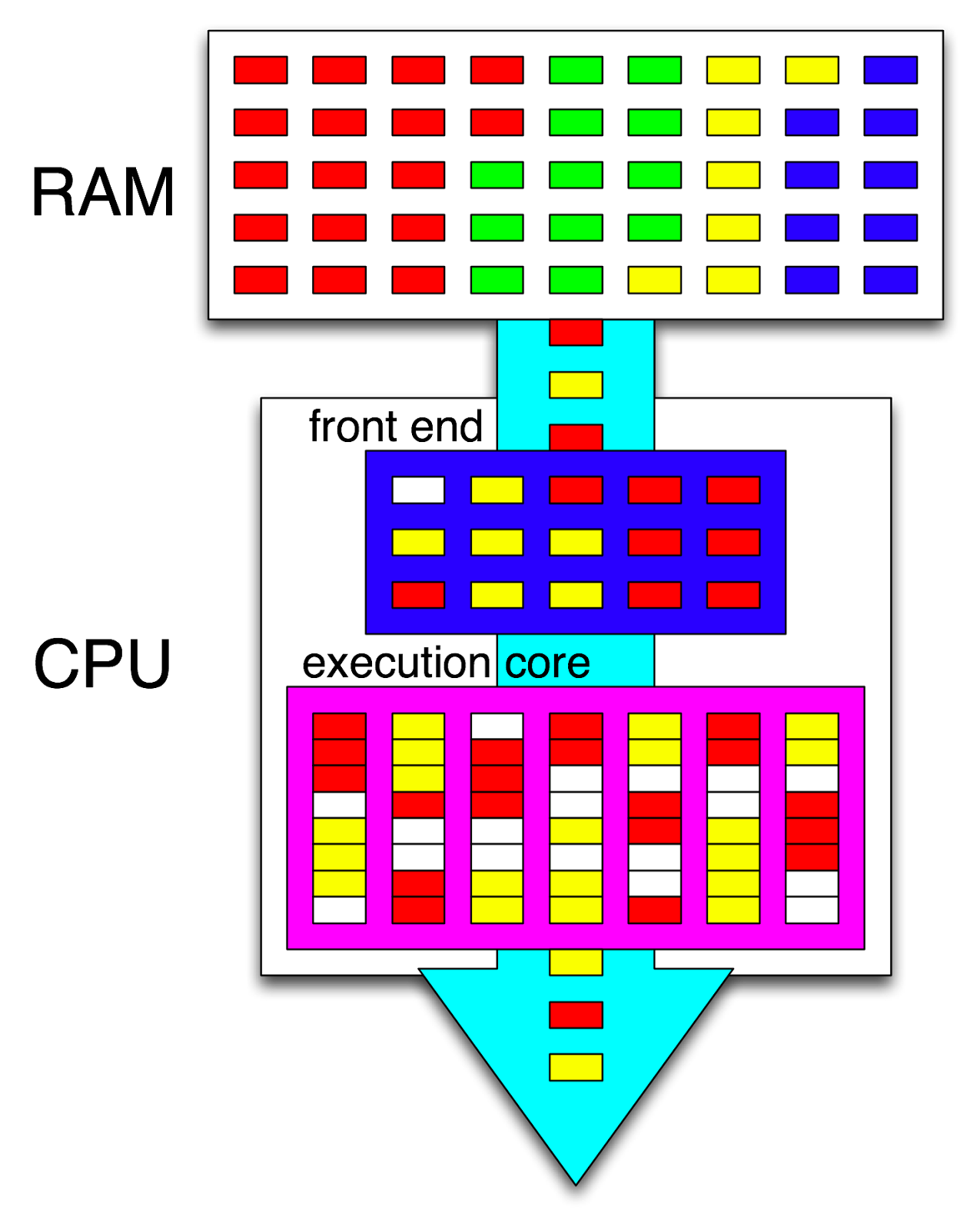
Hyper-Threading is a technology used by some Intel microprocessor s that allows a single microprocessor to act like two separate processors to the operating system and the application program s that use it. It is a feature of Intel's IA-32 processor architecture.


With Hyper-Threading, a microprocessor's "core" processor can execute two (rather than one) concurrent streams (or thread s) of instructions sent by the operating system. Having two streams of execution units to work on allows more work to be done by the processor during each clock cycle . To the operating system, the Hyper-Threading microprocessor appears to be two separate processors. Because most of today's operating systems (such as Windows and Linux) are capable of dividing their work load among multiple processors (this is called symmetric multiprocessing or SMP ), the operating system simply acts as though the Hyper-Threading processor is a pool of two processors